Cloud GPUs cheat sheet
One-page review guide for the Cloud GPUs course. Each block links to the full page.
Performance-optimized, purpose-built AI infrastructure rests on three core components: compute, storage, and networking.
Accelerator types
CPUThe primary component that executes instructions; general-purpose.
GPUHandles a large number of calculation tasks in parallel; ideal for graphics rendering and machine learning.
TPUGoogle's specialized accelerator for neural-network ML, with significant speed/efficiency gains over CPUs and GPUs for those workloads.
Full detail: Accelerated compute.
GPU decision factors
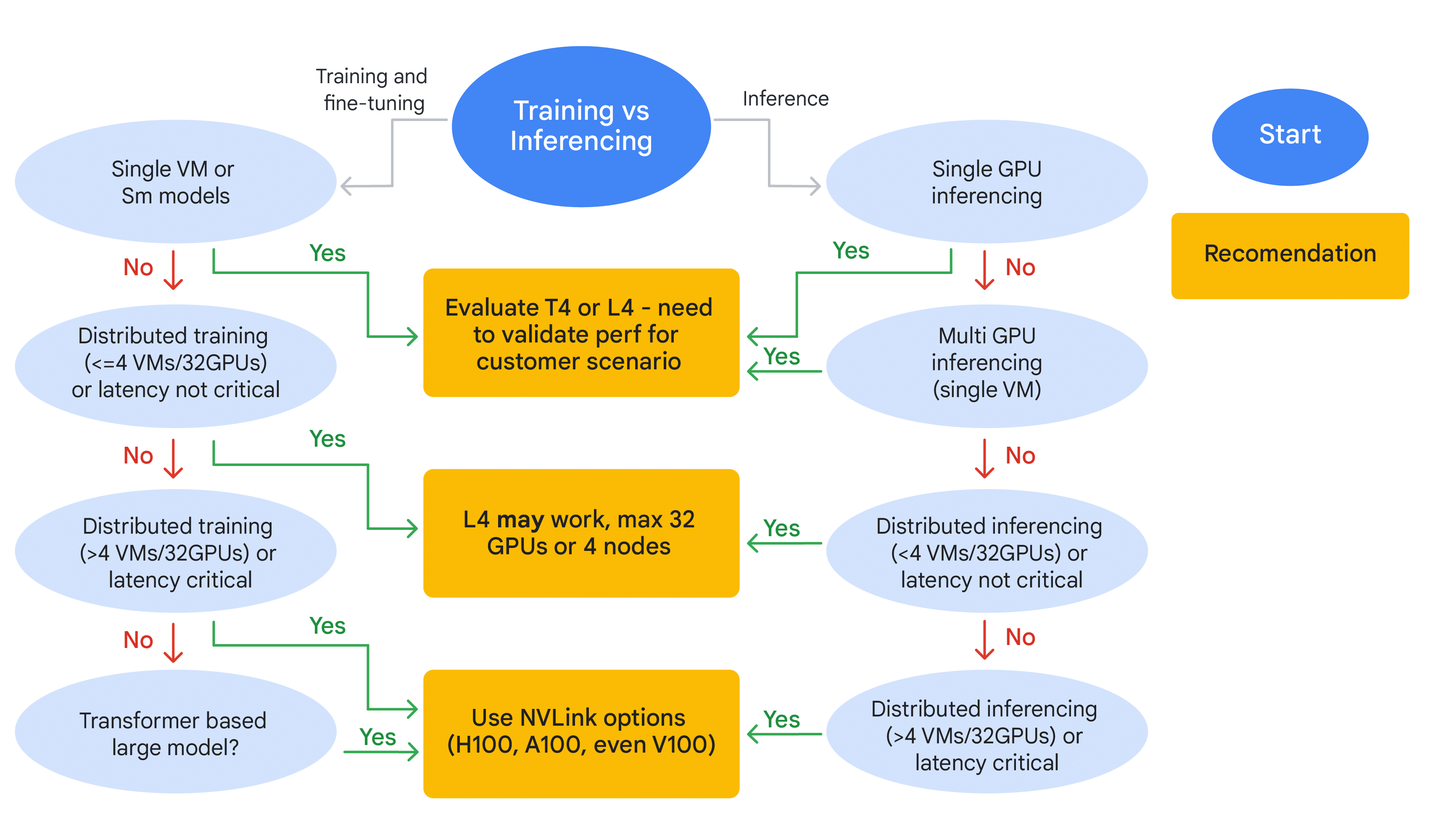
- Distinguish training / fine-tuning from inferencing.
- Scale directly influences the recommended hardware tier.
- Latency is a deciding factor.
- Validate performance for the customer scenario.
GPU options by workload
| Workload | Recommended GPUs |
|---|---|
| Pre-training | A4, A3 Ultra, A3 Mega, A3 High, A2 |
| Fine-tuning | A4, A3 Ultra, A3 Mega, A3 High, A2 |
| Serving inference | A4, A3 Ultra, A3 Mega, A3 High, A2 |
| Graphics-intensive workloads | G2, N1 + T4 |
| High performance computing | Depends on how much computation must be offloaded to the GPU |
Full detail: GPU options.
Provisioning options
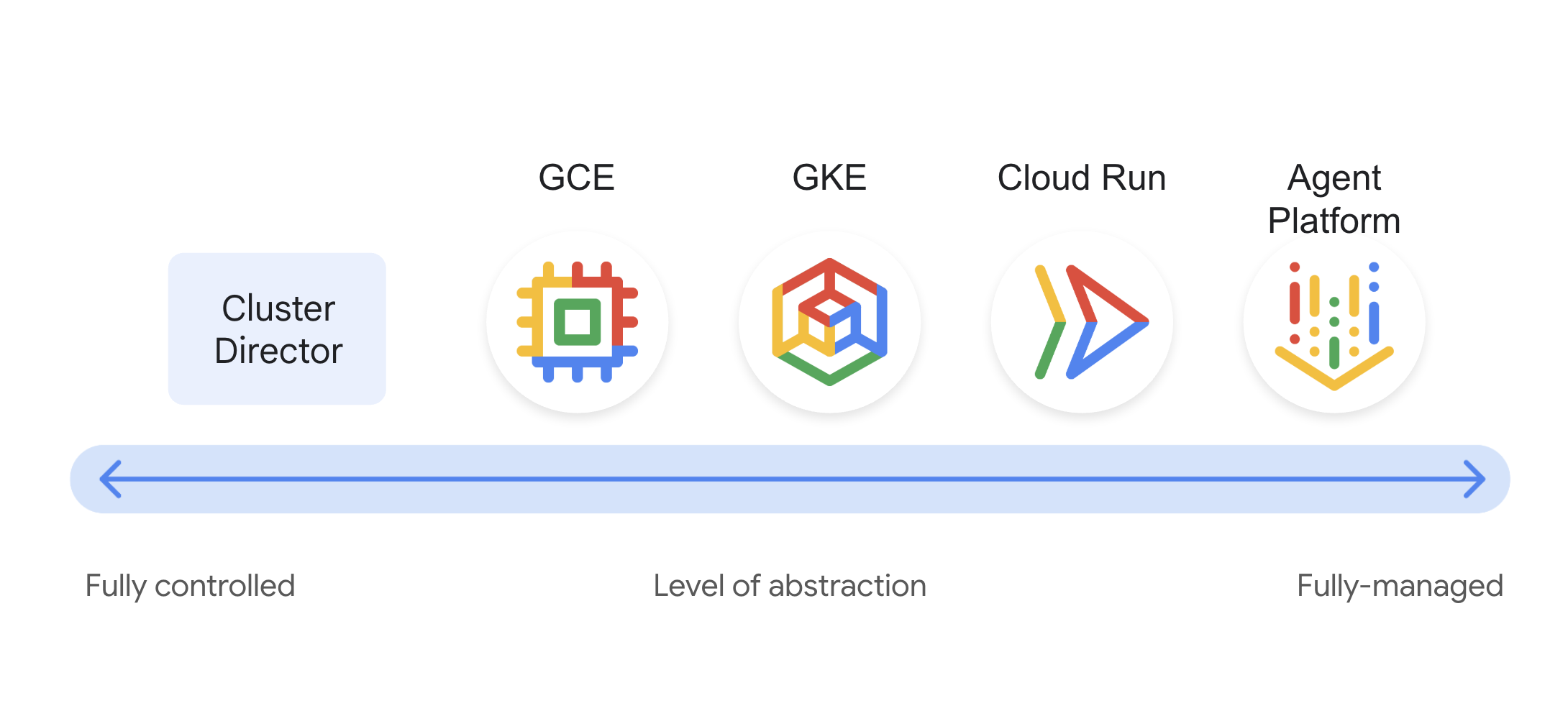
- Cluster Director / GCE - fully control the environment.
- GKE - managed Kubernetes; mid-spectrum abstraction.
- Cloud Run - serverless, higher abstraction.
- Agent Platform - fully managed AI platform.
Full detail: Provisioning options.
Accelerating frameworks
- CUDA (Compute Unified Device Architecture) - NVIDIA's parallel computing platform and programming model.
- XLA (Accelerated Linear Algebra) - domain-specific compiler originally developed by Google.
- PyTorch/XLA - lets PyTorch models leverage XLA's optimizations.
- JAX/XLA - JAX is designed from the ground up with XLA as its core compilation backend.
Full detail: Accelerating frameworks.
Recap
Exam guide§2.1
Consolidated review guide for the AI Infrastructure: Cloud GPU course.