Cloud TPUs cheat sheet
One-page review guide for the Cloud TPUs course. Each block links to the full page.
TPU (Tensor Processing Unit) - a custom application-specific integrated circuit (ASIC) built by Google to accelerate the matrix-heavy computations of machine learning.
When a TPU is the best bet
- Training massive deep-learning models - large-scale, compute-bound training.
- Models relying on embeddings - sparse recommendation / ranking workloads (SparseCore).
- Scientific and healthcare AI - high-throughput scientific computing.
See Use cases and case studies for the scaling architectures behind each.
Google TPU evolution
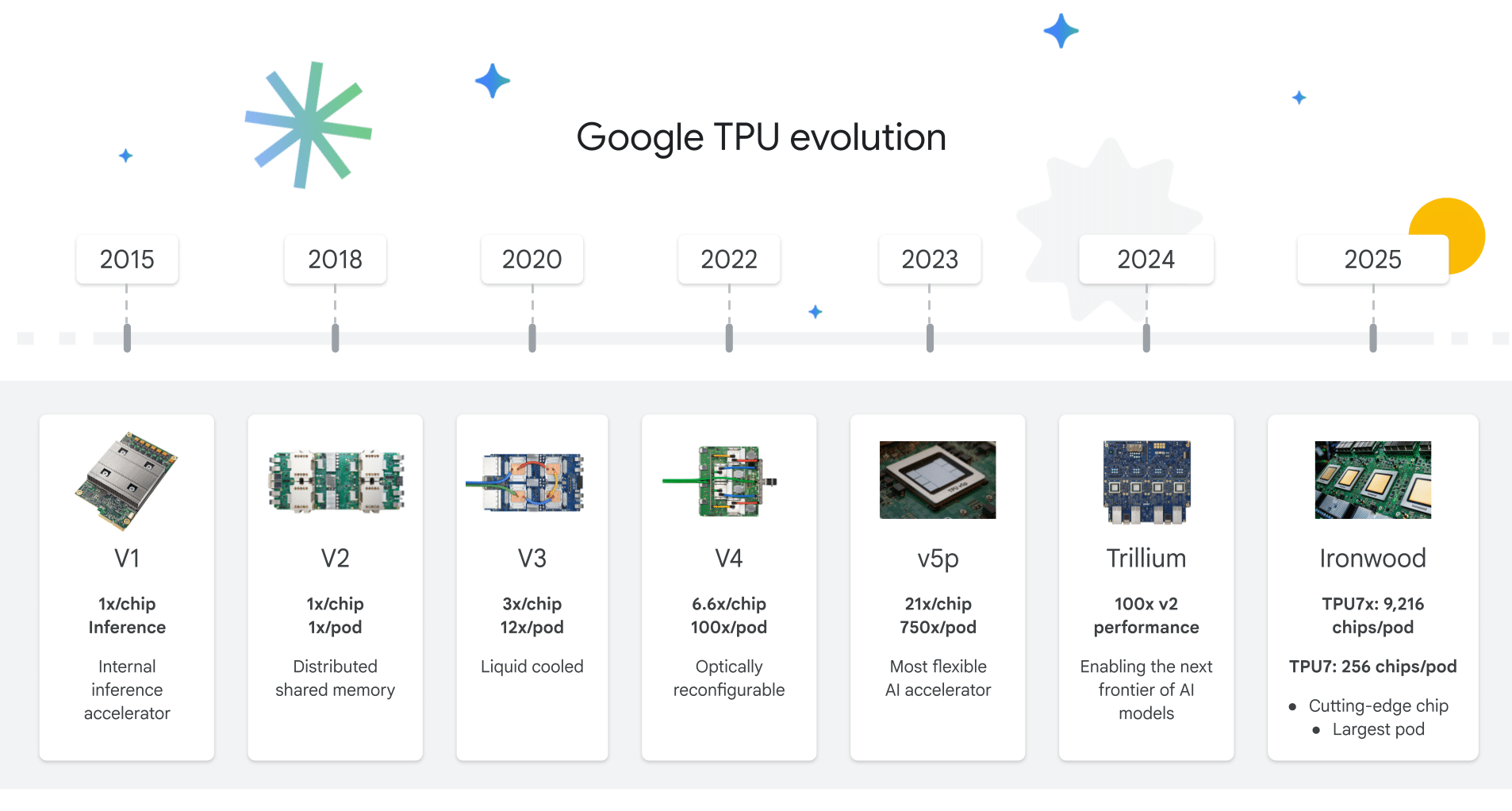
- v1 (2015) - internal inference-only accelerator.
- v2 (2018) - 1x/chip, 1x/pod baseline; distributed shared memory.
- v3 (2020) - 3x/chip, 12x/pod; liquid cooled.
- v4 (2022) - 6.6x/chip, 100x/pod; optically reconfigurable.
- v5p (2023) - 21x/chip, 750x/pod; most flexible AI accelerator.
- Trillium (2024) - ~100x v2 performance; next frontier of AI models.
- Ironwood (2025) - cutting-edge chip, largest pod: TPU 7 = 256 chips/pod, TPU 7x = 9,216 chips/pod.
Full family and specs: TPU hardware versions.
Physical grouping
- Pod - a collection of TPUs physically grouped and connected by a specialized high-speed network.
- Slice - a subset of chips within a single pod, connected by fast Inter-Chip Interconnects (ICI).
- Cube - a 4x4x4 topology of interconnected TPU chips.
Deep dive: TPU system architecture.
Consumption options
- Long-term reservation - request and reserve TPU resources in advance for an extended period.
- On-demand - request resources as soon as possible, keep them as long as you want.
- Spot - cheapest; can be preempted by Google Cloud at any time if capacity is needed elsewhere.
- Flex mode - request hardware for a specified period, from 1 minute to 7 days.
- Calendar mode - create future reservations for hardware you know you'll need in advance.
Full detail: Consumption options.
GPU/TPU interoperability
- Use a dual-container approach within a single pod for seamless GPU/TPU switching.
- The container whose accelerator (GPU or TPU) is present starts its vLLM server; the other sleeps - only the correct server for the underlying hardware runs.
Full detail: GPU/TPU interoperability.
Model development best practices
- Principle 1 - Layout for efficiency - tile-friendly tensor layouts that keep the MXU busy.
- Principle 2 - Fixed shapes for predictable performance - stable tensor shapes avoid recompiles.
- Principle 3 - Avoiding unnecessary padding - TPU-friendly dimensions minimize wasted compute.
Full detail: Model development best practices.
Recap
Exam guide§2.1
Consolidated review guide for the AI Infrastructure: Cloud TPUs course.