Synchronization 4: Monitors, Readers/Writers, Process Structure
Source: UC Berkeley CS162, Fall 2020/2021 - Prof. John Kubiatowicz, Lecture 9
This lecture finishes the synchronization arc by driving one hard problem all the way to a correct solution: the readers/writers problem, solved with a monitor. It is the example that shows why a lock plus condition variables is so much cleaner than raw semaphores. The second half zooms out from the primitives to the container that holds them - the structure of a real process: how each user thread is paired with a kernel thread and stack, how the kernel lays those out in memory, and how a timer interrupt turns that structure into scheduling (the next topic).
Recap: atomic instructions build locks
Everything here rests on hardware atomic read-modify-write instructions. Each one grabs a memory value and updates it in a single, uninterruptible step.
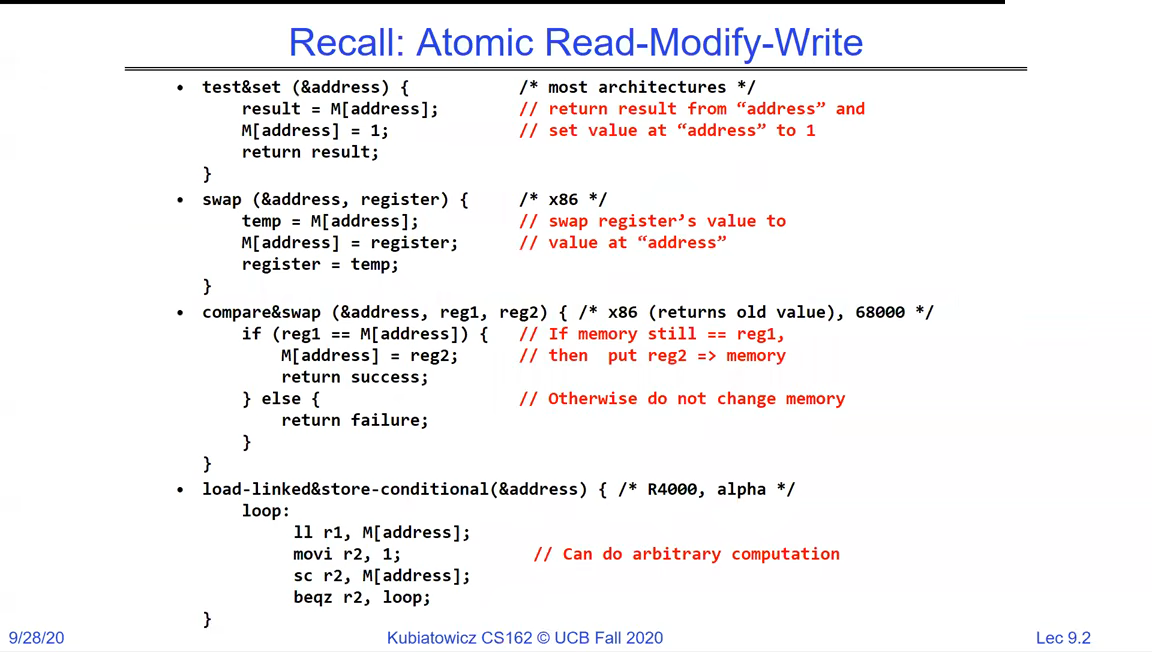
With test&set (or compare&swap) you build a lock that does not busy-wait:
a short guard protects the lock's own metadata, and a thread that finds the
lock busy is put on a wait queue and put to sleep, then handed the lock directly
on release. Real systems (Linux futex) take this further with a three-state
lock - UNLOCKED, LOCKED, CONTESTED - so the uncontended acquire and release
are just a compare&swap in user space and only contention ever enters the
kernel.
Locks give mutual exclusion, but they cannot express a richer rule like "many readers or one writer." For that we need to sleep inside a critical section, which is exactly what monitors add.
Monitors: a lock plus condition variables
A monitor is a lock plus zero or more condition variables, used to manage concurrent access to shared data. It is less a data structure than a programming paradigm - a disciplined way of thinking.
A condition variable is a queue of threads waiting for something to become true while inside the critical section. Its whole purpose is to let a thread go to sleep holding the lock - and have the lock quietly released under the covers so others can make progress, then re-acquired before the sleeper wakes.
wait(&lock)- atomically release the lock and sleep on this condition variable; re-acquire the lock before returning. You must pass the lock so the release can happen atomically with going to sleep.signal- wake one waiter (if any) on this condition variable.broadcast- wake all waiters on this condition variable.- Golden rule - always hold the lock when performing any condition-variable operation.
- Signaling an empty condition variable is a no-op - if nobody is waiting, nothing happens. This is a crucial, defining property (and the reason semaphores cannot stand in for condition variables - see below).
This is precisely what a semaphore cannot do. If you grab a lock and then
call a semaphore's P, you sleep while still holding the lock and deadlock the
system. Condition variables are designed so that going to sleep releases the
lock for you.
The Mesa monitor pattern
There are two flavors of monitor, differing only in what happens on signal.
Hoare monitors transfer the CPU immediately to the woken thread; they have
elegant mathematical properties but are hard on the cache and the scheduler.
Mesa monitors (from Xerox PARC's Mesa OS) simply move the woken thread to the
ready queue and keep running. Mesa is what every real system uses, so it is what
this course uses.
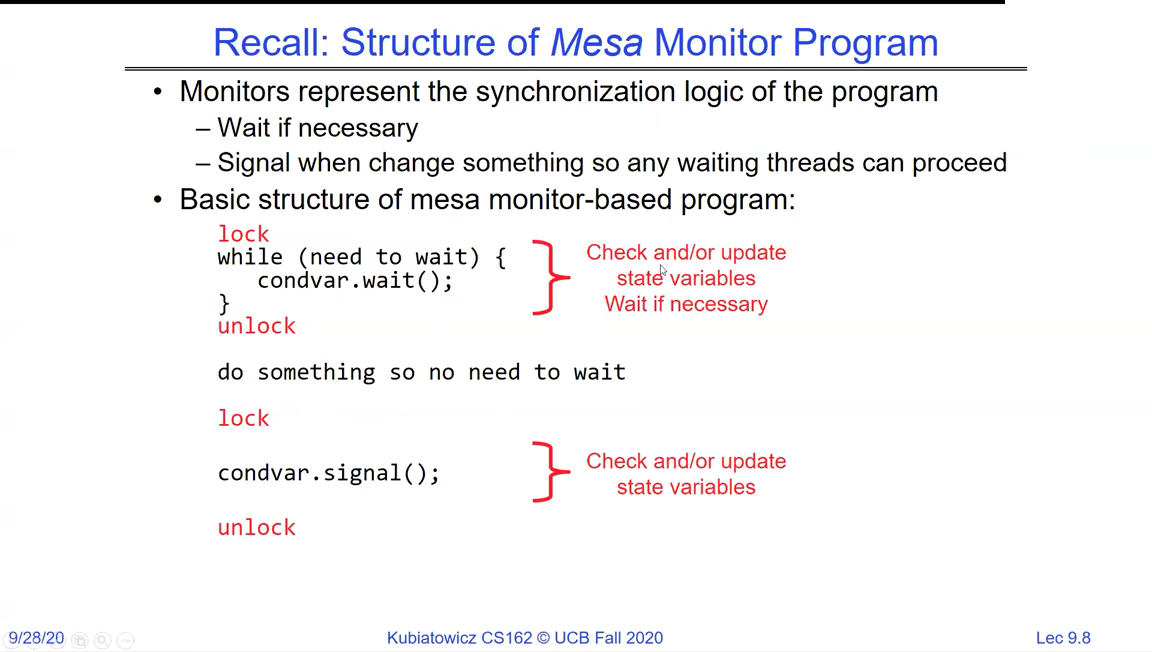
The single most important idea is the while loop. Under Mesa semantics, a
signal only makes you runnable - by the time you actually reacquire the lock
and return from wait, another thread may have slipped in and changed things
back. So on every wake-up you recheck the condition; you only leave the loop
when you hold the lock and the condition holds.
While programming, think of yourself as holding the lock across the entire
region between acquire and release - even while asleep inside wait. None of
the code you see on the screen ever runs without the lock. (Under the covers
wait really does release and reacquire the lock, but you should not reason that
way.) This is what makes monitors powerful: because you "always" hold the lock,
you can inspect several shared variables at once and know nobody can disturb them
between your checks.
The readers/writers problem
Consider a shared database with two classes of users. Readers never modify it; writers read and modify it. The access rules: any number of readers may be active at once, or a single writer, but never both. A writer mid-update can leave the database temporarily inconsistent, so no reader (and no second writer) may be anywhere near it.
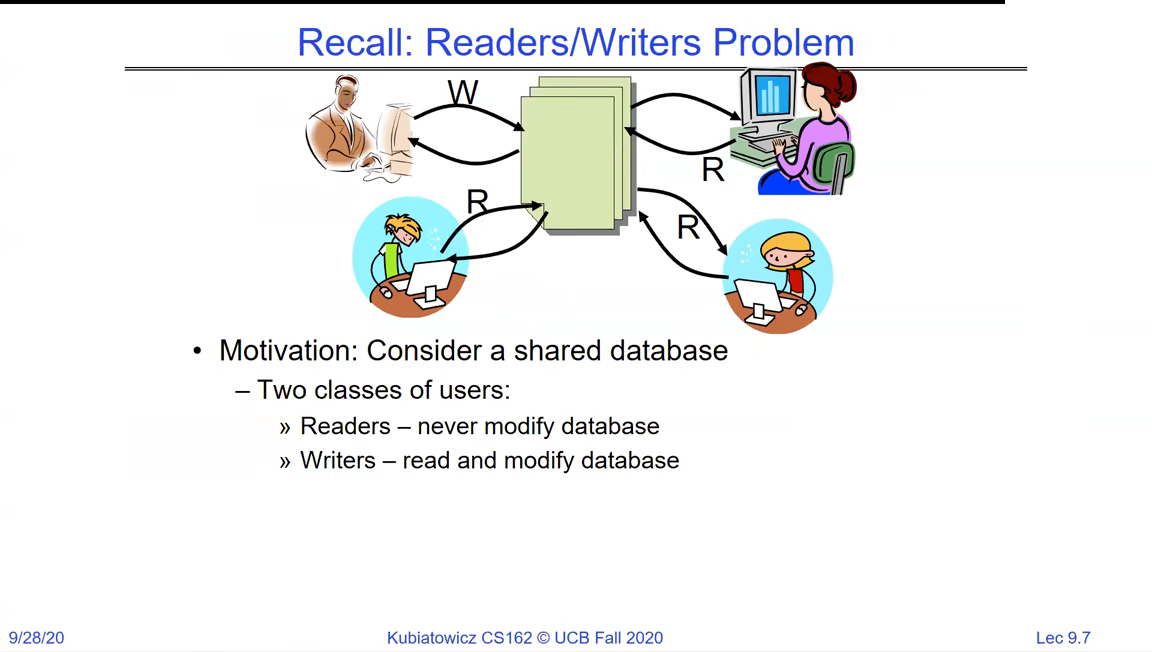
A single lock is insufficient: grab it to read and no other reader can get in, yet we specifically want many concurrent readers. We need something that distinguishes the two classes - a monitor with two condition variables.
The solution: state and structure
The monitor needs to track who is where. That is four integers and two condition variables, all guarded by one lock.
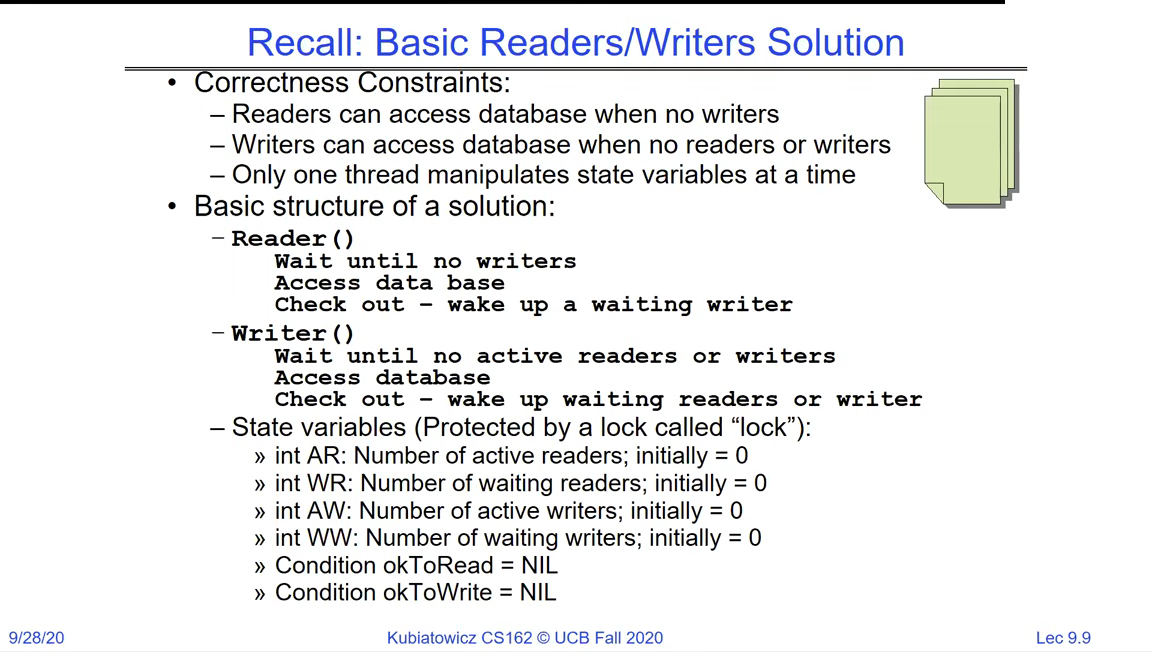
AR- active readers (readers currently in the database).WR- waiting readers (readers ready but blocked).AW- active writers. Its maximum possible value is 1.WW- waiting writers (no upper bound).okToRead,okToWrite- the two condition variables threads sleep on.
The structure of each side is symmetric: wait until it is safe to enter, access the database, then check out and wake whoever should run next. This particular solution gives writers priority - a reader defers to any waiting writer. That is a deliberate choice (writers are usually rarer, and readers usually want the freshest data), and we will see later it is not the only option.
The reader
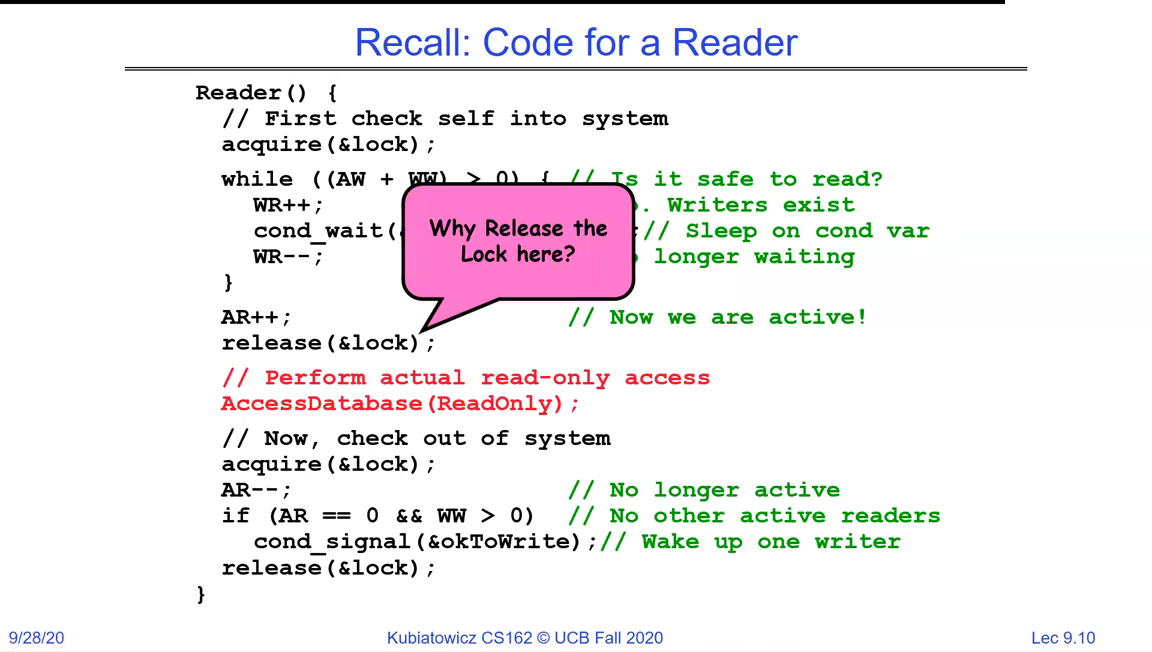
Three subtleties are worth pausing on:
- Why increment
WRonly inside the loop?WRcounts readers asleep on the queue. You bump it right beforewaitand drop it right after, so it is an exact count of sleepers, not of readers loitering outside. - Why release the lock before
AccessDatabase? So that other readers can pass through the entry check and read concurrently. The monitor guards the bookkeeping, not the reading itself. - Why is
AR++safe without extra care? It is a shared variable, but we do it inside the critical section with the lock held, so there is no race.
On exit, if we are the last reader (AR == 0) and a writer is waiting, we wake
one writer. Otherwise there is nothing useful to do - any remaining reader will
handle the wake-up when it leaves.
The writer
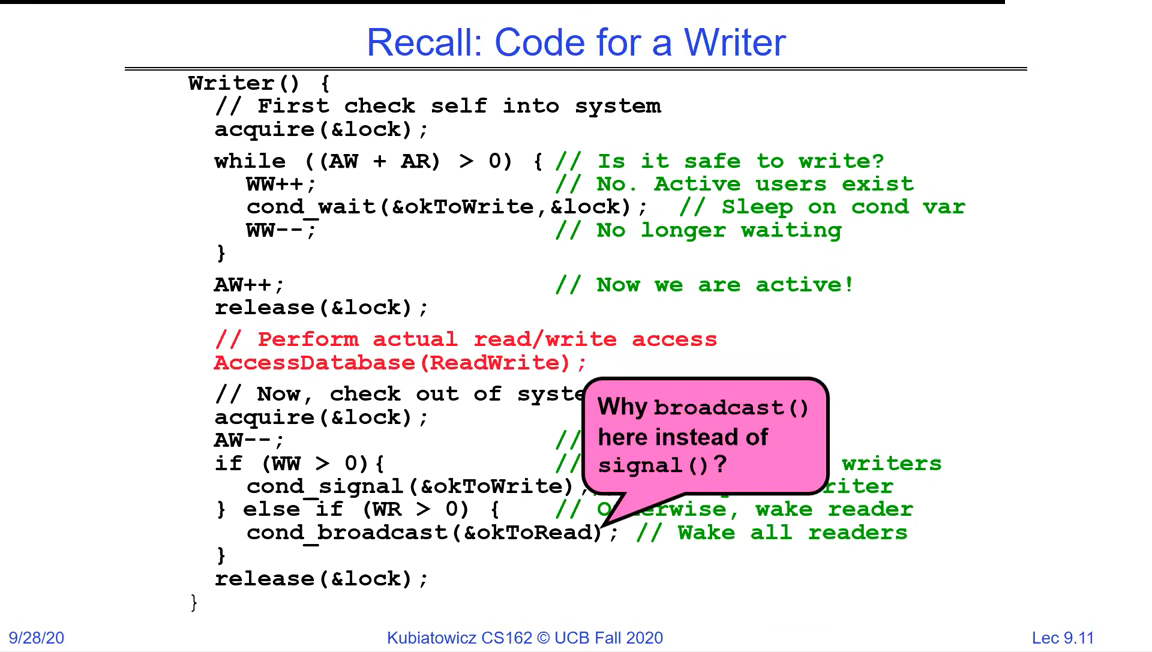
On entry a writer must not broadcast its own class - only one writer can be
active, so waking several just wastes scheduler time as the extras recheck and go
back to sleep. On exit it prefers another waiting writer (signal one) and only
falls back to broadcast(okToRead) when there are no writers left - because many
readers may proceed together, so all of them should wake.
Watching it run
Trace the sequence R1, R2, W1, R3 starting from all-zero state.
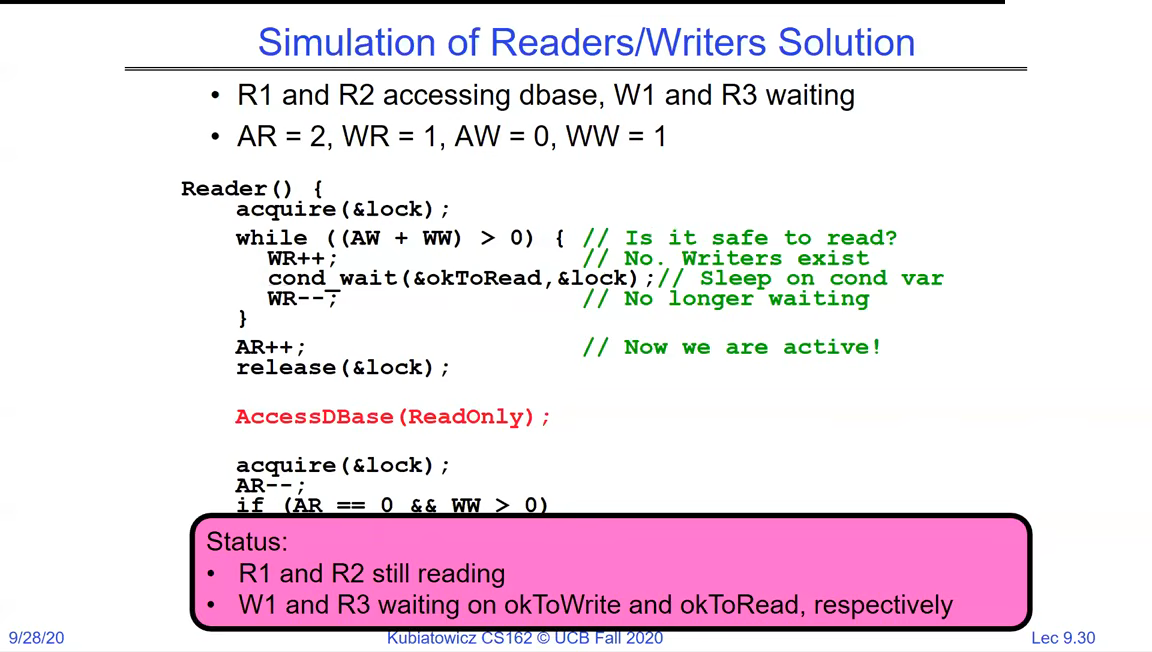
- R1 enters:
AW + WWis 0, so it setsAR = 1and reads. - R2 enters the same way:
AR = 2, two readers concurrent, no lock held during the actual reads. - W1 arrives:
AW + ARis 2, so it bumpsWWand sleeps onokToWrite. - R3 arrives: even though readers are active,
AW + WWis now greater than zero (a writer waits), so R3 bumpsWRand sleeps onokToRead. R3 defers to W1 - writer priority. - R2 finishes:
ARdrops to 1. It is not the last reader, so it signals nobody and just leaves. - R1 finishes:
ARhits 0 andWW > 0, so it signalsokToWrite. Under Mesa this only moves W1 to the ready queue. - W1 runs: it returns from
wait, rechecks -AW + ARis now 0 - exits the loop, setsAW = 1, and writes. - W1 finishes: no waiting writers, but
WR > 0, so it broadcastsokToRead. R3 wakes, and if there were twenty waiting readers they would each grab the lock in turn, decrementWR, incrementAR, and read.
signal just puts the waiter on the ready queue - the signaler keeps running and
even chooses when to release the lock. When the woken thread finally runs, the
implementation of wait tries to reacquire the lock; if someone else holds
it, the thread sleeps again - now on the lock, not on the condition variable.
And which of several waiters wakes is non-deterministic - never assume writers
wake in the order they slept unless you are explicitly told so.
Can readers starve? and how lazy you can be
Yes, readers can starve. With writer priority, a steady stream of arriving
writers keeps AW + WW > 0, so a reader rechecking its condition never gets out
of the loop. Starvation is a real risk of this design.
But Mesa's recheck discipline also makes the code remarkably forgiving.
Suppose you dropped the if (AR == 0 && WW > 0) guard on the reader's exit and
just always signaled a writer. You might wake a writer while readers are still
present - but that writer immediately rechecks AW + AR > 0, sees the readers,
and goes right back to sleep. The entry conditions are self-checking, so an
over-eager or even incorrect signal cannot violate the invariant - it is only
inefficient. You could even replace every signal with broadcast: wake a
thousand writers and only one proceeds; the rest recheck and sleep. This laziness
is the great practical advantage of Mesa scheduling; the only cost is an
occasional extra trip around the loop.
One condition variable instead of two
What if we collapse okToRead and okToWrite into a single okContinue?
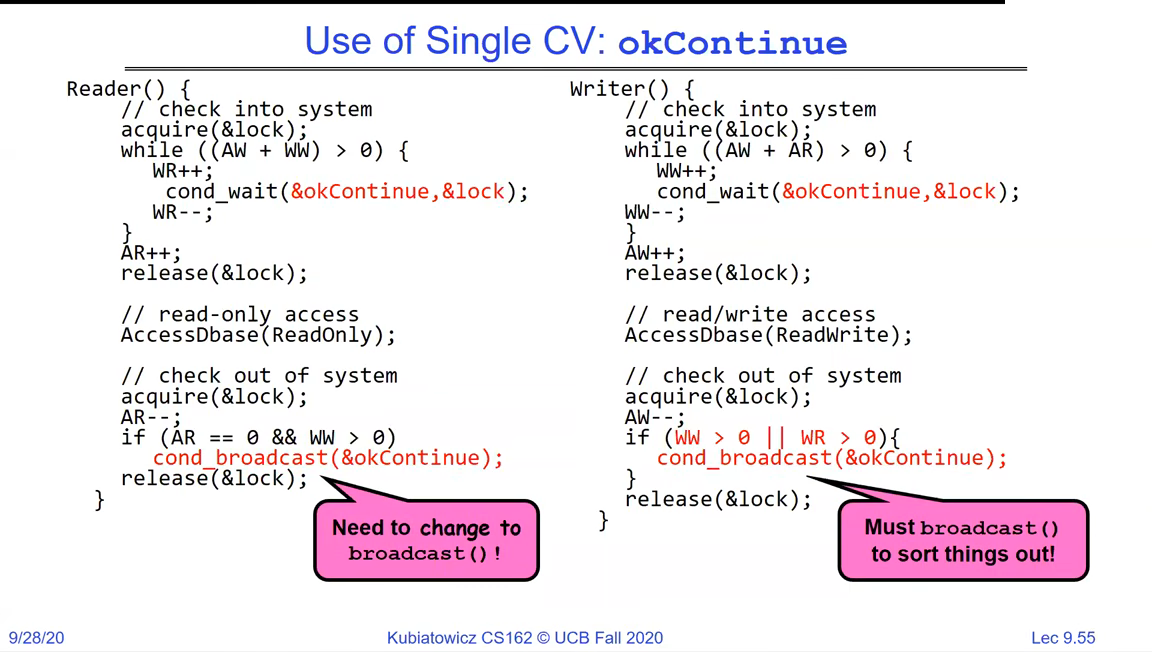
It seems like it should work, but a plain signal can be delivered to the
wrong class - a reader's signal reaching another reader while a writer waits,
for instance. Because we no longer distinguish the queues, we must
broadcast and let every woken thread's own entry check decide whether it
may proceed. That is less efficient (many threads wake only to sleep again), and
it no longer gives strict writer priority - but it is correct. When you get lazy
about state, you sometimes have to get very lazy to stay correct.
Building monitors from semaphores is subtle
Can you implement a condition variable out of a semaphore? A lock is easy (a binary semaphore). Condition variables are not, and the reasons are instructive:
- Naive
wait = P,signal = V. Sleeping on the semaphore while holding the monitor lock deadlocks - same trap as before. wait= release lock,P, reacquire lock;signal=V. No deadlock, but now history matters. A fewsignals before awaitincrement the semaphore, so the laterwaitsails straight through without sleeping. A real monitor'swaitalways sleeps, and asignalto an empty condition variable does nothing.P/Vare commutative;wait/signalare not.signal= "if the queue is non-empty,V". Closer, but semaphores do not let you inspect their queue, and there is a race between releasing the lock and the waiter'sP.
A correct construction does exist (it is in some textbooks, and it turns on keeping an extra integer counter under the lock rather than trusting the semaphore's own history), but the takeaway is the hierarchy: a monitor is a distinct, higher-level abstraction, not just a repackaged semaphore.
Kubiatowicz's own aside: reading these conditions and knowing what to look for takes real practice the first few times. If it feels hard, that is expected - it settles in with exposure.
Language support for locks
The manual acquire/release discipline is fragile: any early return,
longjmp, or thrown exception between them leaks the lock and can wedge the
whole system. Modern languages fix this by tying the release to scope.
| Language | Mechanism | What it does |
|---|---|---|
| C | Manual release on every exit path | You must release before each return, and setjmp/longjmp can jump past your release entirely - error-prone, worse with multiple locks. |
| C++ / Java | try / catch around the critical section | Catch every exception, release, and re-throw - correct but verbose. |
| C++ | RAII guard (lock as a stack local) | The guard is released automatically on any exit from the scope - normal return or exception. Rust does the same with mutex guards. |
| Python | with lock: block | The lock is released however the block is left. with also cleans up files, connections, etc. |
| Java | synchronized keyword | Every object has a built-in lock; a synchronized method acquires it for the call. Java also exposes monitors via wait / notify / notifyAll. |
The monitor discipline these encode is the whole lecture in four rules: acquire the lock before touching shared data; loop while the condition is wrong, sleeping inside the loop; on exit, update state and signal or broadcast; and always release, no matter how you leave.
Process structure: threads and kernel threads
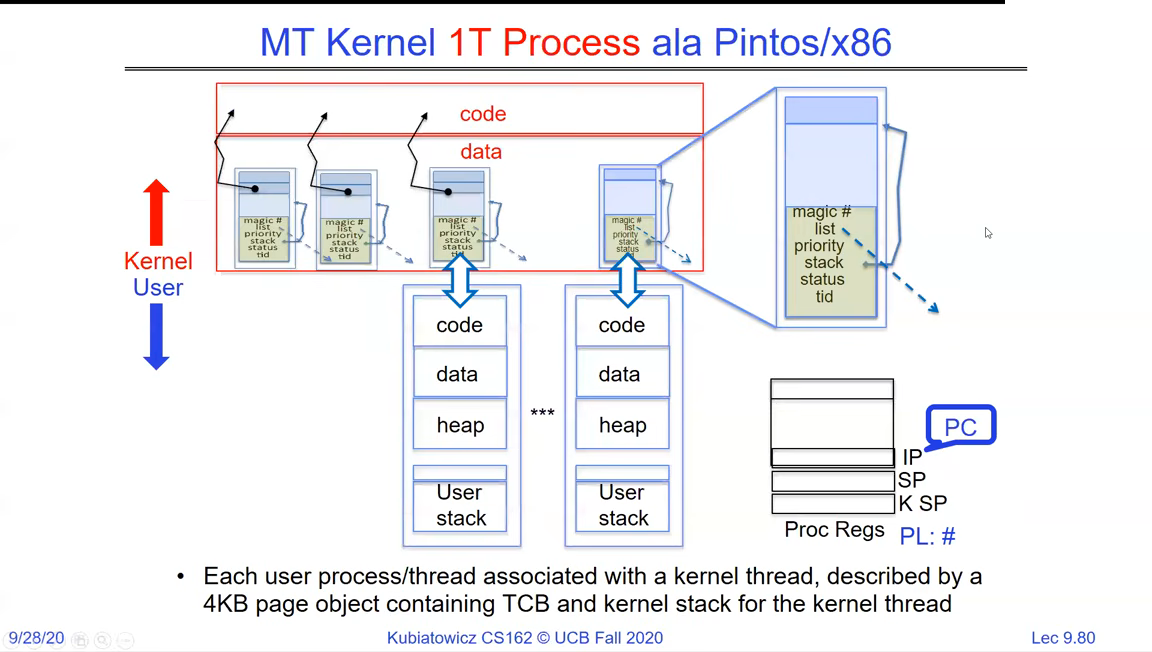
Now step back from the primitives to the process that contains them. In the standard model (Linux, Pintos, CPython) every user thread is paired one-to-one with a kernel thread. For each thread the kernel keeps a TCB (thread control block) and a kernel stack used for system calls, interrupts, and traps. That kernel stack plus its state is often called a "kernel thread" - it is the part that can be suspended and put to sleep inside the kernel. Some kernel threads have no user side at all: they still have a TCB and stack but do work purely for the kernel and never run in user mode.
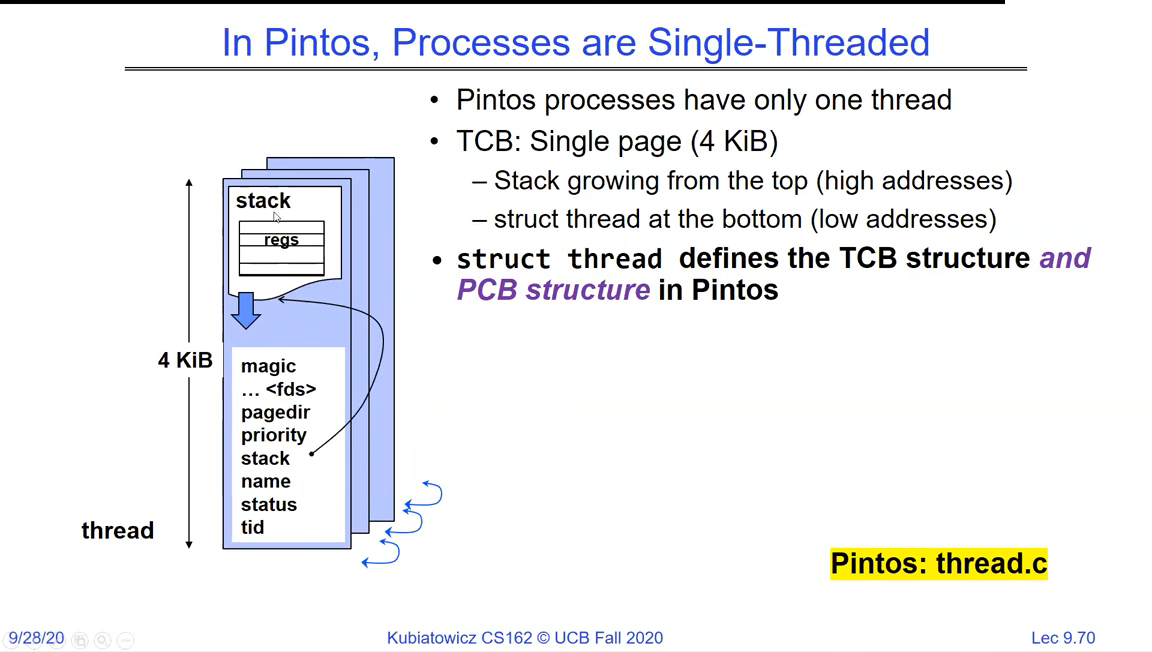
The magic number at the boundary is a sentinel: if the kernel stack overflows
it, the number gets clobbered and you get a hint that something went wrong. The
practical consequence of a 4 KiB page is stark - do not run anything deeply
recursive on a Pintos kernel stack.
- Pintos - a single 4 KiB page holds both the TCB and the kernel stack (so the usable stack is a little under 4 KiB).
- Linux - 8 KiB (two pages) per thread, with the stack and a
task_struct(holding thread and optional process state) at opposite ends.
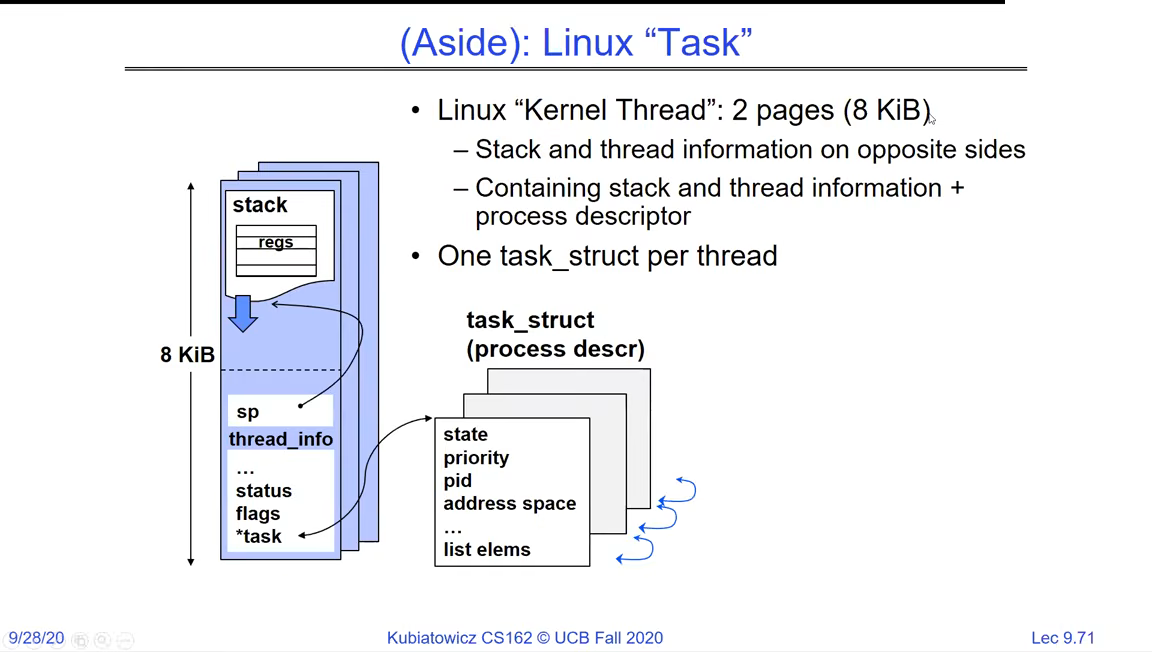
Traditionally a multithreaded process has one PCB per process, and that PCB points to many TCBs - one per thread. Pintos is the easy case: exactly one thread per process, so the TCB and PCB collapse into a single struct.
Kernel structure: shared code, per-thread stacks
Putting it together, the kernel holds shared code, globals, and heap for all kernel code, plus a separate kernel stack for every thread.
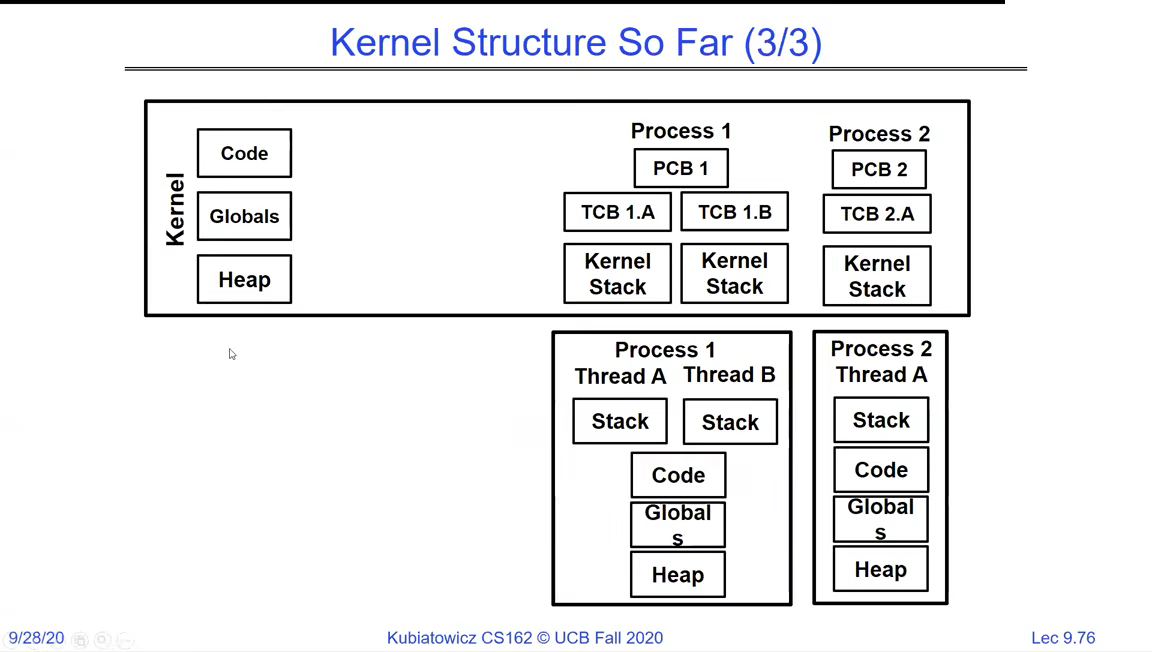
A common misconception is that kernel data lives on the stack. It does not have to - the kernel has a full heap and global area, so long-lived structures like pipes are stored there and simply protected from user access.
Kernel crossings and the road to scheduling
When a running user thread takes an interrupt or system call, the x86 immediately
switches to that thread's kernel stack (its address sits in the TSS
structure), then saves the user PC, stack pointer, and other registers onto the
kernel stack. Now the CPU runs kernel code on the kernel stack; to return, it
restores those saved registers and executes iret, landing back in user mode
right where it left off.
Every thread that has a kernel thread is schedulable. On a timer interrupt,
the handler bumps the thread's tick counters; if the thread has run too long it
sets a yield flag, and on the way out of the interrupt the kernel puts the current
thread back on the ready queue and calls schedule, which picks the next thread
and calls switch. Because the switch swaps kernel stacks, the eventual "return
from interrupt" returns onto a different thread's stack - and thread B is now
running instead of thread A. That decision of who runs next is scheduling, the
subject of the next lecture.
The classic switch routine - which returns onto another thread's stack - carried
Dennis Ritchie's famous Unix V6 comment: "You are not expected to understand
this." Even the authors flagged context-switch code as the trickiest thing in
the kernel. Treat switch as the code you cannot get wrong.
Address space and the kernel
Every process runs in its own virtual address space, mapped to physical memory through a page table. The kernel's portion is mapped into the top of every process's address space, but flagged supervisor-only.
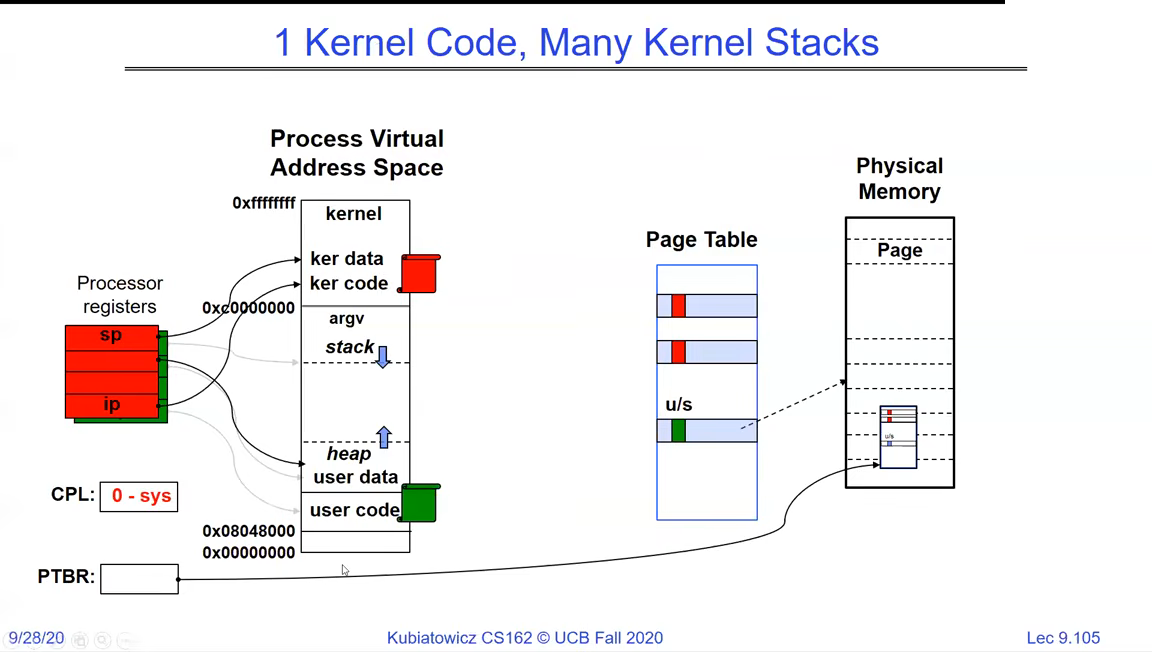
The page table entry's user/supervisor bit decides who may touch a page. In user mode (privilege level 3) the kernel pages fault; the instant an interrupt drops the CPU to level 0, those same pages become available - so the kernel is fully protected yet always addressable. Switching which process you are in means switching the page-table base register; switching between threads of the same process does not, since they share one address space.
Recap
- A monitor is a lock plus one or more condition variables. Always
acquire the lock before touching shared data; wait inside a
whileloop; on a change,signalorbroadcast; and you may only sleep while holding the lock. - The readers/writers solution - four counters, two condition variables, one lock - lets many readers or one writer proceed, and shows how clean monitors are compared to raw semaphores. This version gives writers priority, so readers can starve.
- Mesa semantics (recheck on wake) make the code forgiving: an incorrect or
over-eager signal is inefficient, never unsafe, because entry conditions are
self-checking. With one shared condition variable you must
broadcast. - Condition variables are not just semaphores -
signalto an empty queue is a no-op andwaitalways sleeps, which naive semaphore constructions get wrong. - A process is one PCB pointing at one or more TCBs; each thread has a kernel thread (TCB plus kernel stack, 4 KiB in Pintos, 8 KiB in Linux) that lets it block in the kernel independently.
- Every kernel thread is schedulable; a timer interrupt saves user state on
the kernel stack, and
switchreturns onto the next thread's stack - which is exactly how scheduling, the next topic, works.